
Note for photo credit: Microsoft Stock Images
Industry has continually evolved in response to new technologies, changing markets, and growing customer expectations. Every industrial revolution has transformed the way businesses manufacture products, manage operations, and compete. Today, the conversation is shifting toward Industry 5.0, an approach that combines intelligent technology with human creativity and sustainable business practices. For entrepreneurs, this evolution is about more than adopting new tools. It is about building organizations that are flexible, efficient, and prepared for long-term growth.
How Industry Reached This Point
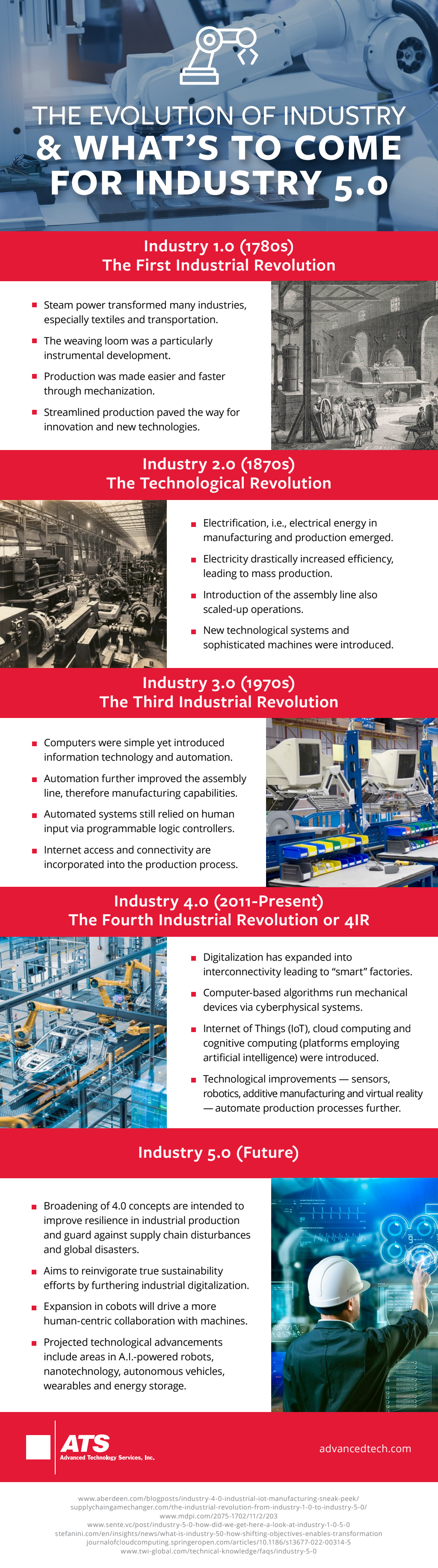
The First Industrial Revolution introduced steam-powered machinery, allowing manufacturers to produce goods on a much larger scale than manual labor alone. Production increased, transportation improved, and industrial economies expanded.
The Second Industrial Revolution brought electricity, assembly lines, and standardized manufacturing. Businesses became more efficient, lowered production costs, and supplied products to growing consumer markets.
The Third Industrial Revolution introduced computers, digital controls, and programmable machinery. Automation improved precision while reducing repetitive manual work. Businesses gained better control over production quality and operational consistency.
Industry 4.0 expanded these capabilities through connected machines, cloud computing, artificial intelligence, and real-time data collection. Equipment could communicate with other systems, allowing manufacturers to monitor production, predict maintenance needs, and make faster operational decisions.
The Shift to Industry 5.0
Industry 5.0 builds upon digital technology while restoring greater emphasis on people. Rather than viewing automation as a replacement for employees, businesses increasingly use technology to support human expertise.
Artificial intelligence can process large amounts of production data, identify trends, and recommend improvements. Employees continue to contribute critical thinking, creativity, leadership, and decision making that remain difficult to automate. This partnership allows organizations to improve efficiency while remaining adaptable when customer demands or market conditions change.
Sustainability Becomes Part of Daily Operations
Industry 5.0 encourages businesses to consider environmental performance alongside financial performance. Companies are reducing waste, improving energy efficiency, and using production data to make smarter operational decisions.
Better visibility into inventory, equipment usage, and production schedules often reduces unnecessary consumption. Improvements in areas such as storeroom management help manufacturers maintain accurate inventory, reduce excess purchasing, and improve workflow without disrupting production. These operational improvements support both cost control and responsible resource use.
Why Entrepreneurs Should Pay Attention
Industry 5.0 is not limited to large manufacturing companies. Small businesses can also benefit from automation, connected equipment, cloud-based software, and data analytics.
Entrepreneurs who invest in technology while continuing to develop employee skills are often better prepared to respond to changing customer expectations. Flexible operations also allow businesses to recover more quickly from supply chain disruptions, labor shortages, or shifting market conditions. Companies that encourage continuous learning alongside technology adoption are better positioned to remain competitive over time.
Industry has progressed through several major transformations, with each one creating new opportunities for business growth. Industry 5.0 represents the next chapter by combining advanced technology with human expertise, operational efficiency, and sustainability. Entrepreneurs who begin adopting these principles today can build stronger organizations that are prepared for future challenges. Look over the accompanying infographic below for more information.