
Ask a judge how well new lawyers handle a witness and the answer is not encouraging. In a survey of more than 4,000 judges and 4,000 attorneys carried out for the Committee on Legal Education Admissions Reform, two thirds of judges said that attorneys in their first five years of practice only sometimes, rarely or never conducted direct and cross examinations competently.
The attorneys were no kinder about the rest of it. Fifty-five percent said new lawyers arrived poorly prepared to question and interview witnesses. Sixty-one percent said the same about negotiation. Asked whether newly admitted lawyers were very or extremely well prepared to communicate with a client, seven percent said yes.
Mohammad Sarris did not need the survey. He is a law student in the United Arab Emirates, and he noticed the same gap from the other side of it: years spent reading cases, very few hours spent doing the things a case demands.
He is 17, and he has spent the past stretch of his studies building the thing he was missing.

Mohammad Sarris, founder of Auravel Legal.
What the platform does
Auravel Legal is a litigation simulator. A user picks a case from a library filtered by practice area, jurisdiction and difficulty, then works it: reads the file, examines the evidence, interviews a simulated client, takes a deposition, and argues in front of an AI judge with AI opposing counsel on the other side.
The scope is wider than the age of its founder would suggest. Cases run across the United Arab Emirates, England and Wales, US federal courts, France and Qatar, with the Court of Justice of the European Union, the European Court of Human Rights, the International Court of Justice and the Delaware Court of Chancery also represented. Practice areas run from criminal and family law to antitrust, intellectual property and international arbitration. The interface is built in English, French and Spanish. There is an AI mentor that will explain doctrine but, in the platform’s own words, leaves strategy to the student. Users can form virtual firms, take the managing partner’s chair and recruit.
Research results are drawn from named official sources, including the UAE Official Gazette and the justice ministries of the UAE and Qatar. The company states that its research tool never fabricates legal authorities, a pointed promise in a market where invented citations have already reached real court filings.
A subscription costs $20 a month, and there is a free trial before that.
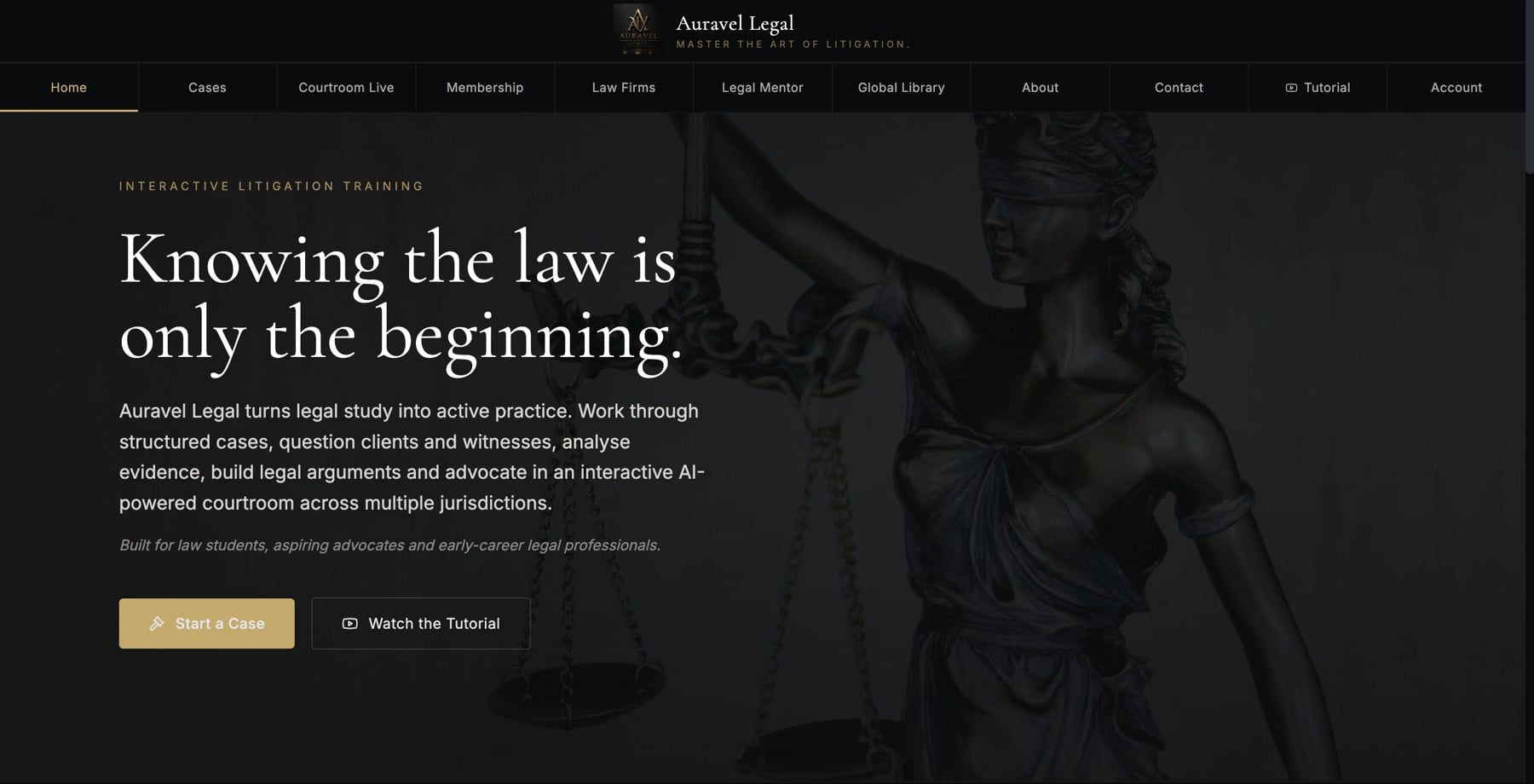
The Auravel Legal interface.
What it refuses to claim
Open almost any page and a disclaimer sits at the bottom of it. Auravel Legal does not provide legal advice. It does not provide legal representation. It does not replace accredited legal education. The AI judges and witnesses carry labels saying they are simulations, and the virtual firms carry labels saying they are not real firms.
A teenager selling software to law students could have been vaguer about all of that, and the vagueness would have sold better. Sarris was not vague, and it is the first thing a sceptical law faculty would check.
He applies the same discipline to his own story. He says the product could not lean on his age to be taken seriously, so it had to stand on its own, which kept him testing and rebuilding instead of calling it finished.
The examiners have reached the same conclusion
The skills he simulates are the ones the profession has just decided to start testing.
The NextGen bar exam launches in July 2026, with most American jurisdictions moving to it by 2028. Alongside legal research and writing, it tests investigation and evaluation, client counseling and advising, negotiation and dispute resolution, and client relationship management. Those are not doctrinal subjects. They are things you do, and they are close to a list of what Auravel Legal asks a student to practise.
He did not build to the syllabus. He started from the same complaint the examiners started from, and arrived in roughly the same place.
What he claims
His claim is narrow. Simulation does not stand in for a training contract, a pupillage or a clinic. His argument is that the repetitions have to happen somewhere, and that most students get very few of them before the first time one counts.
“You do not need to wait until you feel completely qualified to start solving a problem you genuinely understand,” he says.
The ambition behind it is large enough: more jurisdictions, deeper simulations, and work alongside universities and legal professionals to keep the educational value real. What he wants is a student walking into a first client meeting having already sat through dozens of them.
Two thirds of the judges surveyed would tell you there is room for it.
About Auravel Legal
Auravel Legal is an educational litigation simulation platform for law students, aspiring advocates and early-career legal professionals, founded by Mohammad Sarris. It covers case preparation, client and witness interaction, legal research, evidence analysis and courtroom advocacy across multiple jurisdictions. It is an educational simulation and does not provide legal advice or legal representation. More at auravellegal.com.
auravellegal.com · instagram.com/auravellegal · tiktok.com/@auravellegal · youtube.com/@auravellegal