
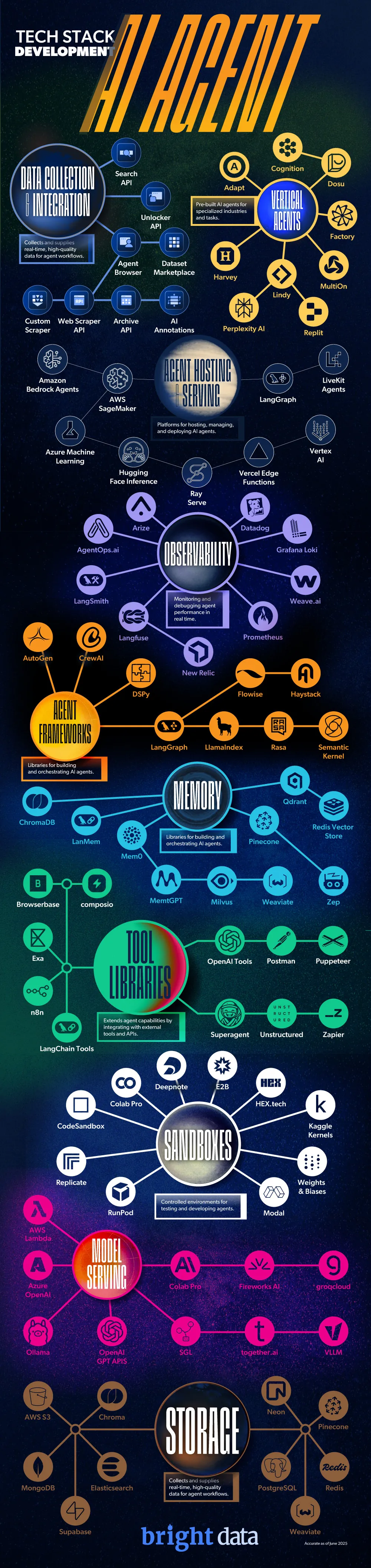
AI agents are emerging as one of the most powerful tools at the disposal of employees. They can independently run their own tasks, such as conducting research, making decisions, writing communications, and even running entire workflows. Some employees are even treating these agents as personal assistants or thought partners during their everyday responsibilities. However, while most users think of their AI agent as the chat interface they give prompts to, there are a lot of tools below the surface that enable these outputs, often called the tech stack.
There are many tools and systems that make up these layers, including agent frameworks, observability tools, memory and storage, and agent hosting platforms. Each plays its own special role in enabling agents to retain context, learn from past interactions, and produce helpful outputs. However, the most important layer in the entire tech stack is by far the data the AI agent has access to. Without access to current, high-quality information, mostly found from the public web, even the most well-built agents won’t be able to produce relevant outputs. APIs like Search API and Unlocker API help these agents connect to the web in real time and scour the Internet quickly for the most helpful information.
Source: Bright Data